During this week’s meeting, the changing of the ritual we selected was introduced.
Since I did Hafez’s book during Yalda night, through Professor Shah’s rearranging example I began to realize that even the smallest changes can make the biggest impacts on a ritual. Details are critical since we can connect the physical with the mental, subconsciously or consciously during rituals.
He specifically mentioned that instead of it being Hafez’s book it could be any book, like Harry Potter for example, where friends would gather around before exams to get advice from one of the novels from the series.
I really liked this way of thinking because it makes me think about these rituals more holistically. I become so tied down to what is already in place that I struggle to imagine what could be beyond it. Again, another thing I need to work on as a designer.
With that said I did grow up with the ritual, so I did feel tied down by tradition and experience.
I’m starting to think that I can’t influence people with my own design decisions until I push myself to be convinced by them myself. Nothing radical can be made unless it is something radical to me as well, not just because I said it is.
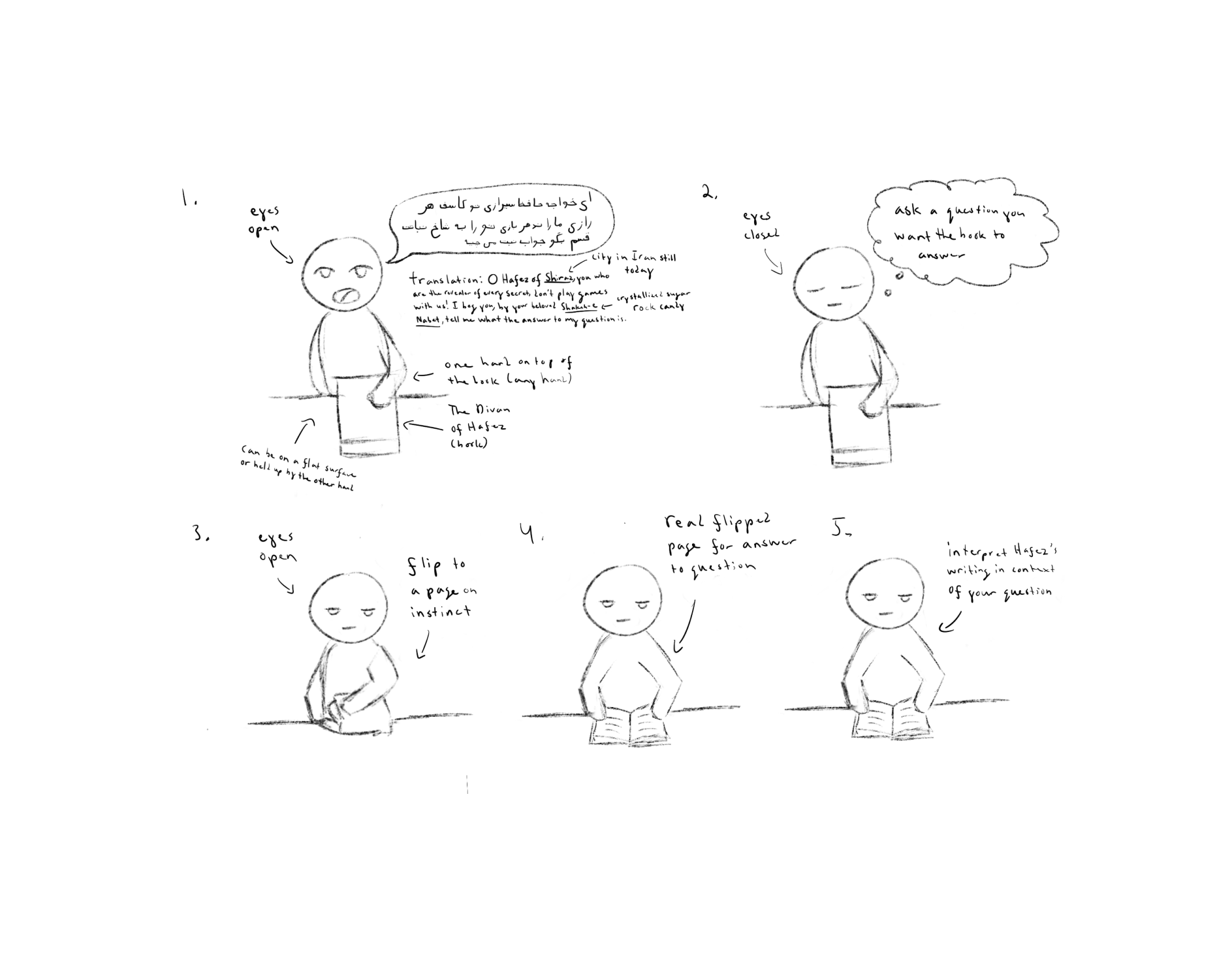
Below is the description and storyboard of my chosen ritual:
On Yalda (birth/rebirth) night, the winter solstice, aka the longest night of the year, is celebrated by those who practice ancient Persian traditions. Families gather around and stay up late into the night eating red colored food (watermelon, pomegranate etc. to symbolize the crimson dawn), tell stories, and have their own fortune told by Hafez. Hafez is the most important poet in Persian culture and his book “The Divan of Hafez” is a collection of his poems of wisdom. Doing this ritual is like calling upon his spirit as “he can answer your question” via the poem you happen to turn to.