This week our discussion was mainly focused on our interpretation of the key findings in “Art is an Experience” by John Dewey. Mabel and I read this chapter prior to our weekly meeting and we were able to discuss and identify a few key ideas.
Below is an image of our grouped thoughts, with Professor Shah’s insights included.
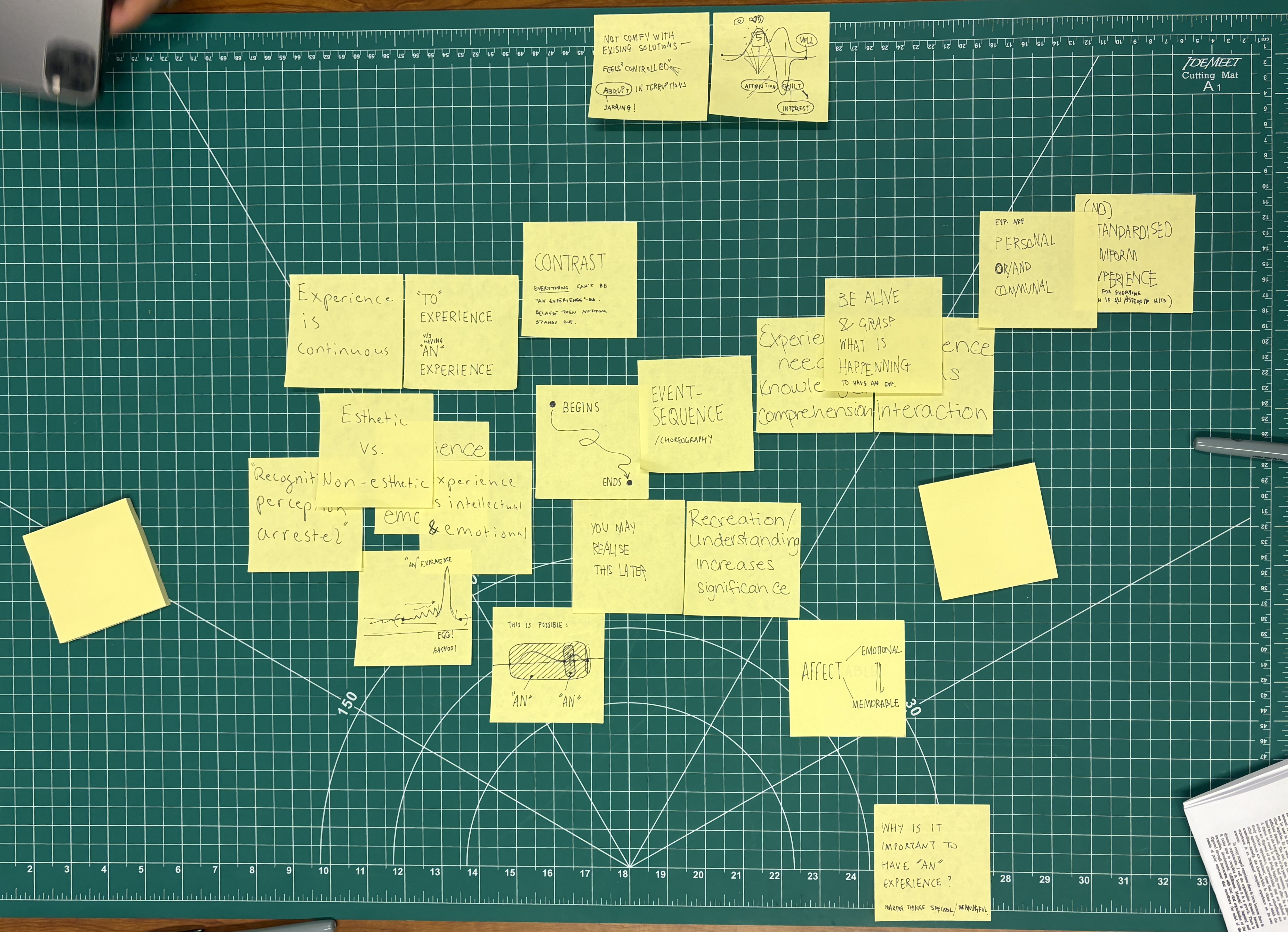
I really enjoyed reading Dewey’s work as the conceptual ideas he laid out in this chapter felt different from how we define experience today in the modern world. It felt like I was reading what experience was to its core and I find it to be incredibly interesting. Classical literature is something I occasionally enjoy reading in my spare time and this felt like an intersection between that kind of writing and the ideas behind user experience.
I think it is really simple to get lost in the meaning behind UX when it is reduced to certain phrases, methods, or tools. Good UX is beyond what can be offered at the surface level. As an undergraduate student spending 4 years earning a degree in this discipline, I want to walk away with more than just “knowing what to do”.
In pursuit of our next steps in research, we were asked to focus more on the problem we discussed last week. I’ve been told several times that the scope of my issue seems to be too broad. I agree to a certain extent.
With further conversation in our meeting, I went on a ramble, and I said it is not that I can’t stay organised with time it is simply that it makes me too uncomfortable. The abrupt jolt of alarms, the exhaustion of opening apps, recalling everything at the right time, etc. makes me believe there is a better way to go about this. I know there is a better way to go about this.
I had briefly brainstormed during the meeting the concept of having an app (ironically) with geolocation that can populate the necessary things I need to recall without having to rely on an alarm. It can just appear on my screen given where I am. For example, if I have questions for a particular class my phone will have a notification appear (preferably a silent one that populates on my screen and stays there) to remind me of the question I had for that class. Or, if I step into Target instead of remembering to look at my list of groceries, the groceries appear on their own because I had set that specific Target as my location for groceries.
This doesn’t fully address the issue but as Professor Shah had said, we just need to focus on one particular aspect.
As part of our work until our next meeting, we’ve been asked to change one thing about how we’re currently going about our issues. Professor Shah had said that sometimes the slightest difference can make the biggest impact.
As a result, I’ve changed the ringtone of the alarms for class (because I need to set one 15 minutes before each otherwise I miss lecture) and my wakeup alarm to a song I particularly find calming.
I used the first 30 seconds of “Marginalia #65” by Masakatsu Takagi. (I’m listening to this song as I write this)
I’m curious to see just how much it’ll have an impact because this song is something I’ve listen to dozens of times when I’m overwhelmed.
It is a piano piece, a song with a single instrument and no vocals is sometimes the exact amount of stimulus I need to think things through.
Until then, I’m going to pay extra attention to how I feel when these new alarms go off throughout the week.